Sunday, November 8, 2009

Blog about the weekend

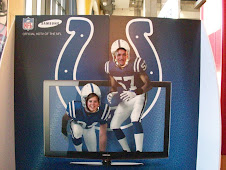
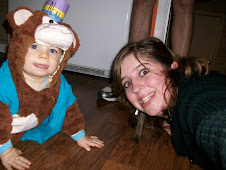
As promised to a few of you, I wanted to provide a little update about my weekend in Indy! First, you can see our picture on their website (fan photos) by following this link: http://www.printroom.com/ViewGalleryPhoto.asp?evgroupid=0&userid=IndianapolisColts&gallery_id=1834596&image_id=59&pos=60
We made signs (which you can see in the picture) and then got on the big screen at the game too. Apparently, we were sitting in the family section too, but the families must have been those of some of the benchwarmers because they didn't get too excited about anyone on the field.
I'm in the process of posting lots of pictures to my facebook page, but I added some here for fun. They are all taken from our seats, with not a whole lot of zoom.
Let's start off with Dallas Clark. I absolutely adore him.
With the uprights in the background, pregame. Dallas Clark is back there somewhere.
The one end-zone has some fun stuff for fans--you can put yourself at a press conference podium, or on a plane next to McAfee. Here's one with the cheerleaders right before the Colts come out at the start of the game:
It was a close game, but a missed Texan's fieldgoal at the end ensured our victory: 20-17. GO COLTS!
Be sure to check facebook for more pictures, and I will see you in class Wednesday!

Wednesday, November 4, 2009

Research!

My research inquiry topic is:
Investigating Writing: How can we encourage students to write?

My research questions are:
1) What kinds of writing are crucial for students to learn?
2) How do state and federal standards play a part in the writing curriculum?
3) How can we engage students in writing while helping them meet those standards?
4) How can we prepare and excite students for writing outside of the classroom?

My sources are:
Book: In The Middle. There are great ideas for getting students involved in the writing process and thinking of themselves as characters, narrators, etc. Since I want to teach middle school, I think this is one of the better books to use.
Article: "From the personal to the public: Conceptions of creative writing in higher education" by Gregory Light. This article examines an older age group, so I think it will be interesting to see how the writing process changes/scaffolds from one year to the next.
Article: "The Effects of School-Based Writing-to-Learn Inverventions on Academic Achievement: A Meta-Analysis" by Robert L. Banger-Drowns, Marlene M. Hurley, and Barbara Wilkinson. The article focuses on keywords such as cognitive strategies, learning strategies, and writing to learn.

To be honest, I have not gotten very far on this at all, due to a mixed-up Methods schedule and an unexpected (and quite unwelcome!) illness. I have passages selected from In The Middle but have not yet gone in-depth with my articles. This is something I will look at before class next week and get ideas on. Also, I am going to talk to Brooke about her experience with writing in the classroom, so she will be one of my "interviewees." I am also going to ask some eighth-graders about the writing they do in school and how they feel about it. I think these interviews will add some personal context to my paper.

Graphic Novels and starting a Revolution!

I enjoyed this book-it was well-written and I enjoyed the simple complexity of the illustrations. There was so much going on, and I really liked how everything tied together. Covering this difficult topic in such a "fun" way is exciting for me. I like that it isn't as heavy as some other books (like the one written by the "Fatwa Man" - sorry, I can't remember his name or the title!)

The article did a lot for me but I wasn't sure if there was too much focus on how it helps the writing, and not the reading. The "teachers" gave the students writing assignments and text-less stories, so were they really helping the students become better readers? I think they were effective in making the students good story-tellers, but are they really better readers or writers? It seemed like there were plenty of errors in the writing, but I am curious about whether those errors were corrected in final versions of their stories. I am interested to see what you all thought in class tonight!

Wednesday, October 28, 2009

The Book Thief

I really enjoyed this book and think it could be used well in a classroom! I am observing an 8th grade class right now that is focusing on short stories, and right now they are specifically focused on characterization (in the next few weeks they will move to plot, point of view, etc.)
I think this book would be a great one for students to read on their own if they need help coming up with a creative POV for a writing assignment. I would also love to teach at least segments of this book to help students with POV, also.
The narration style in this book really got to me, once I figured out who the narrator was and why there were so many "death updates." It is an innovative voice through which to hear the story, and I appreciate Zusak's use of an abstract narrator.
I was also glad to see that "death" was pretty kind, and at least sympathetic.
Overall, I think this story would be a great one to use in a classroom (maybe 11th/12th grade?). However, it would be neat to use excerpts in an 8th grade classroom when teaching Anne Frank. I think they would go well together and the class could compare/contrast the experiences of a non-Jewish German and a Jewish German in Nazi Germany.

Tuesday, October 13, 2009

Finding Identity

After reading American Born Chinese and Josh's post, I thought I'd post a picture of our favorite controversy-prone pop star, Miley!


American Born Chinese was intriguing to me, from the title to the very last page. Note that the title is not American-Born Chinese (meaning it is a Chinese person born in America) but it is American Born Chinese, meaning it is an American who is born Chinese. This really hit me as I was reading the story because I realized how little Jin wanted to do with his Chinese heritage. He only wanted to be American and wanted to cut all ties with the Chinese/Asian culture.
This was especially evident to me on page 37 when he tells Wei-Chin to "Speak English" even though Wei-Chin was speaking perfect English. It's like Jin thinks that those not born in America really aren't worthy of acting American. Does he feel that way about his own parents?
I also saw this with Jin's hair, when he tries out Greg's hair-do. Instead of making him fit in with the American crowd, though, he is laughed at by the white Americans and the Asian-Americans.

All of this made me wonder, How do we construct our identity? Is it based on our heritage or where we live? Does it matter what we look like or do we base this just on what we feel inside?

I thought a lot about the article with this book and how we construct our identities. The article's writer had some good ideas when he examined his name. He let the students know where his name came from and what was important to him, and tied them together. Through this look into himself, he was able to identify himself and his ideas in teaching.

I love the activities presented in the article as well. I hope I am nothing like Mrs. Keller in the future, but there parts of Mr. Rosewald's and Ms. Bennington's classrooms that I liked. Giving students freedom to examine and write what is valuable to them is a great way to make students care about what they read. Mrs. Keller's lecturing style would not be helpful to very many students in an English classroom, though it may have a place in other subjects.

Both the article and the book were helpful to me in asking identifying questions. I can take tips away from the article and use them in my future classroom, and I will also be able to reflect on American Born Chinese when looking at my students. It will help me to understand where they are coming from and the struggles they face to identify themselves in a world where so often appearance is everything.

Tuesday, October 6, 2009

Monster

Out of every book we have read so far, Monster is my favorite. I thought the way this one was written was excellent and I felt that this was most successful in tackling a difficult issue in a way that we can easily teach our students.

Hade's article was also beneficial to read after reading the novel. I appreciated his noting that a white illustrator drawing a black family eating watermelon is shown as irresponsible, because that person is just using stereotypes. I think that authors do that frequently, whether they are whites writing about different races (like the Native American example he gives in the article) or men writing about women, or rich writing about the poor. These authors use stereotypes to provide readers with an image of their characters because they do not know enough about the kinds of people they write about to portray something more accurate.

One of the things I loved most in Monster was that it was told from Steve's POV, and it seemed realistic to me (though after reading Hade's article, maybe I am too uneducated to know if that is realistic or not.) In this book, the black characters were not all portrayed as uneducated, lazy, and vulgar. Some, yes, used poor English when they spoke, but the majority of what we read was well-written and well-spoken. Also, Hade's idea that sometimes multiculturalism seems very forced in books has a lot of merit. In Monster, though, it seemed very natural because it was integral to the novel.

I found it interesting that Steve describes the one detective as a light-skinned black man. The sentence echoed society's opinion to me. The fairer the skin of the black man, the better he must be, right? (This in turn made me think of Chris Rock's new movie coming out, Good Hair. Black women try to make their hair look as "white" as possible... Beyonce, anyone?)
Anyway, back on topic... I thought he must have noted that the detective was light-skinned for a reason. Clearly, he could not be in as successful a position if his skin were a few shades darker. And even though he is successful, he's not in charge. (Think also of characters in Cold Case, Law & Order: SVU.)

The ending felt very real to me. The whole time, Steve's lawyer is telling him "The jury has all the information they need, just by looking at you" but she makes it seem like she is past the prejudices. Then, at the end, she has won her case and turns her back on Steve when he wants to give her a thank-you hug. It shows that even though people can say they are not prejudiced, when it comes down to it they often harbor negative feelings toward people who are different.

As Hade points out, this isn't just done with race. So many people will give money to charities but won't shake hands or talk to someone who is homeless and on the streets. In fact, many people send their money in an envelope to a big organization instead of going downtown and volunteering an hour in a homeless shelter's food line. Plus, men and women are constantly stereotyping each other because they cannot really imagine what it is like to live in the other sex's shoes. I know this is going to be stereotyping and overgeneralizing, but bear with me. Men don't think women know anything about cars or sports. At my part time job, I find myself in excited conversations about sports all the time. My one coworker is a huge Phillies fan and I am a huge Colts fan. She will often tell me about great plays that she has seen at the games, and I will do my best to teach her about football, and to explain to her that a "first down" is not the one yard line. Our customers always end up laughing because there we are, two girls, talking about sports. One of my former coworkers, a male I will refer to as "E" wrote on one of my recent facebook status updates that girls aren't allowed to play fantasy football, because I didn't know the name of the quarterback on my fantasy oponent's team. Yet guys are supposed to get really into fantasy football, but half the guys in our league didn't bother to update their starters for this past week's game, even though their starters all had a bye week.

I know that was rambling, but that just really got to me this week, and after reading Hade's article I think we can all think about a time when we have been victims of a misunderstanding of different "cultures."

Thursday, October 1, 2009

Related to class last night

Hey everyone, I wanted to give you all the chance to watch the "Pole Dancing Miley" video on YouTube if you were curious about it after class last nigh: http://www.youtube.com/watch?v=QxUr2ggLlhI

There is the link for it. I think more than the "pole dancing" (which really only lasts about 2 seconds), I was really surprised at what she is wearing! Her bra is hanging out (a look that middle schoolers were copying at my church a week later!) and her shorts are super short. She is 16 or 17 in this video and her father supports it. I think it's a little too much. She even had a stalker in Georgia where she was filming a movie recently, and it was a guy who was "in love with her" according to his own words. People start forgetting that these girls are still just teens because of how they dress.

(Also at the Teen Choice Awards: Dane Cook. Didn't quite get that one. Here is a clip of what he has to say to a room full of teenagers--- http://www.youtube.com/watch?v=5EW6rUEPxVU)


And, finally, because I absolutely love these shirts (or not!), I thought I would include the new t-shirts from Hollister that you have probably all seen anyway. Exploiting teen sexuality? I say yes.


In case you can't read them, they say "Girls just wanna have sun," Legal-ISH," "What Tan Lines?" Save a Wave Ride a Surfer," I <3 the Woody," and "The twins are quite a handful."